
(This one is about an 8 minute read.)
Anyone who has recovered from an ACL injury has been there. Your PT asks you to "squeeze your quad," as if it's the easiest thing in the world. (It sure used to be!)
So, you give it your best effort. You do exactly what you would have done before the ACL injury to engage the quad. But... nothing.
You stare at the quad harder, you tell the brain, "just squeeze it!" You twist your body a little, strain your face, tense every muscle in your body.
Yet, nothing happens. The kneecap doesn't move, the muscle stays soft, and the leg you've trusted your whole life suddenly feels like it belongs to someone else.
If this sounds familiar, take a breath. You've found the right place.
Everything with your ACL recovery is just as it should be. There's nothing wrong with the graft or anything else associated with your recovery. While it may not feel like it, in the land of ACL recoveries... this is completely normal.
Because your knee has suffered a relatively significant injury, your brain has decided to deactivate the quad - in an attempt to protect the knee.
The name for this quad deactivation is called arthrogenic muscle inhibition (AMI). You are far from alone in experiencing arthrogenic muscle inhibition.
A 2024 study of 300 athletes with a fresh ACL tear found that 170 of the athletes (56.7%) had arthrogenic muscle inhibition before surgery. [1]
What Is Arthrogenic Muscle Inhibition?
Arthrogenic muscle inhibition (a mouthful, I know) is the term used for when the brain shuts down a muscle because something is wrong in the joint next to it. "Arthrogenic" means it starts in the joint, and "inhibition" means the brain is holding the muscle back.
The way I like to explain it is that there are sensors in and around your knee that are constantly soaking up information about what's going on in the joint.
They're asking questions like:
Is there swelling here?
How much pressure is in the joint?
Are any of the tissues damaged?
The sensors pass this information through the nervous system, which is the control system of your body. Every time you attempt to fire the quad, the sensors are essentially asking the nervous system, "are you okay firing this muscle?"
Most times after an ACL injury, the answer is a very loud and resounding "no." The nervous system is not ok with firing the quad, because it realizes there is a significant injury in the knee. It believes that if it fired the quad, it would put force through the knee, potentially causing further damage.
Therefore, the brain turns down the ability to turn on the quad to keep you from loading a knee it doesn't trust yet.
That's why the first few weeks can feel so strange. In most cases the quad is still there and still capable of working.
What's missing is the signal from the brain telling it to fire. The muscle only starts to shrink later, because the muscle isn't being used.
Is My Quad Weak, Or Is The Signal Not Getting Through?
You can get a pretty good idea on your own by sitting on the floor with both legs straight out in front of you. Squeeze the quad on your good leg first, as hard as you can, and watch what happens. The kneecap slides up, the back of the knee presses into the floor, and the muscle just above the knee gets firm.
Now do the same thing on your ACL leg and ask yourself a few questions. Does the kneecap move? Can you press the back of the knee flat into the floor? If you lift the leg straight up off the floor, does the knee bend a little as it comes up (what PTs call a "quad lag")?
If the quad doesn't engage and the kneecap barely moves, it tells us that the signal isn't getting through the way it should.
Every athlete's recovery is a little different. For some athletes, the quad comes back within a session or two of simple exercises.
For others, it takes a little longer and more specific, detailed work.
(As an aside, there could be one other factor contributing to difficulty with quad engagement and straightening the knee after an ACL injury.
Sometimes, the hamstring, or muscle on the back of your thigh, can become very tight after an ACL injury. The tightness in this muscle actively prevents the quad from being able to engage as well and get the knee straight. If this sounds like you, I talk about it more in this video on full extension and pain.)
Why It Matters To Turn It Back On Early
In no way do I want this information to scare you. My goal with all of my articles is to help you see that this is perfectly normal for ACL injuries. And also to help you develop an understanding of the "why" behind a few of the challenges you might face.
With this information in mind, you'll be able to understand your role in an efficient, successful recovery, as much as possible.
So, here's why it is important to turn the quad back on as soon as you can in the ACL recovery process.
The quad's job is to create and absorb force around the knee.
Every time your foot hits the ground, it is the quad's responsibility to absorb force, so that it doesn't go into the knee.
When the brain keeps the quad turned down for too long, other tissue has to take on that force. This could mean that the knee is taking on more force during a time when it is trying to actively recover, which would delay recovery a bit.
Your brain will also start to find workarounds for using the quad or "compensation patterns".
You might find yourself shifting your weight to the good leg or walking with a slight bend in the knee. These compensation patterns get more ingrained the longer they go on, and they're a little harder to undo at month six than at week three.
The good news is that the early weeks are exactly when you have the most room to change this (the ACL recovery timeline shows where these weeks fit in the bigger picture).
What You Can Do Today (For Free)
There's a simple study I really like on this, published in the Journal of Athletic Training in 2014, that took 30 athletes who'd had ACL reconstruction and split them into three groups for two weeks. One group iced the knee, one group did quad exercises, and the third group iced the knee for 20 minutes and then did the exercises right after.
Only the third group got stronger, going from 1.6 to 2.2 Nm/kg of quad strength in two weeks, while the ice-only and exercise-only groups didn't change in any meaningful way. [2] My read is that the ice quiets the alarm in the joint long enough for the quad to hear the signal, and the exercise is what teaches the brain to use it again.
This is how I'd put that to work at home, as long as your surgeon and PT have cleared you for ice and quad work.
Ice the front and back of the knee for 20 minutes. The study used two bags of crushed ice held on with an elastic wrap.
Right after, sit on the floor with both legs straight. Put your hands on your good leg, just above the knee on the inner and outer side (the VMO and VL, two parts of the quad). Squeeze hard and learn what a full contraction feels like under your fingers.
Move your hands to the same spots on your ACL leg and try to find that same feeling. Your hands give the brain one more way to locate the muscle.
When you find the contraction, hold it and time the hold. Do 10 of these, rest, and try to beat your best hold each day.
Keep your pain at a 2 out of 10 or below. If it climbs above a 2, stop for the day and come back to it tomorrow (and always stay within your surgeon's guidelines).
After a few days of this, check in with yourself and notice what has changed. Is the squeeze on the ACL leg stronger than it was? Can you feel the inner quad fire now, even a little? Does the kneecap move more than it did on day one? Small changes here are real progress, so pay attention to them.
What If My Quad Still Won't Fire?
If the quad still won't fire, we can help.
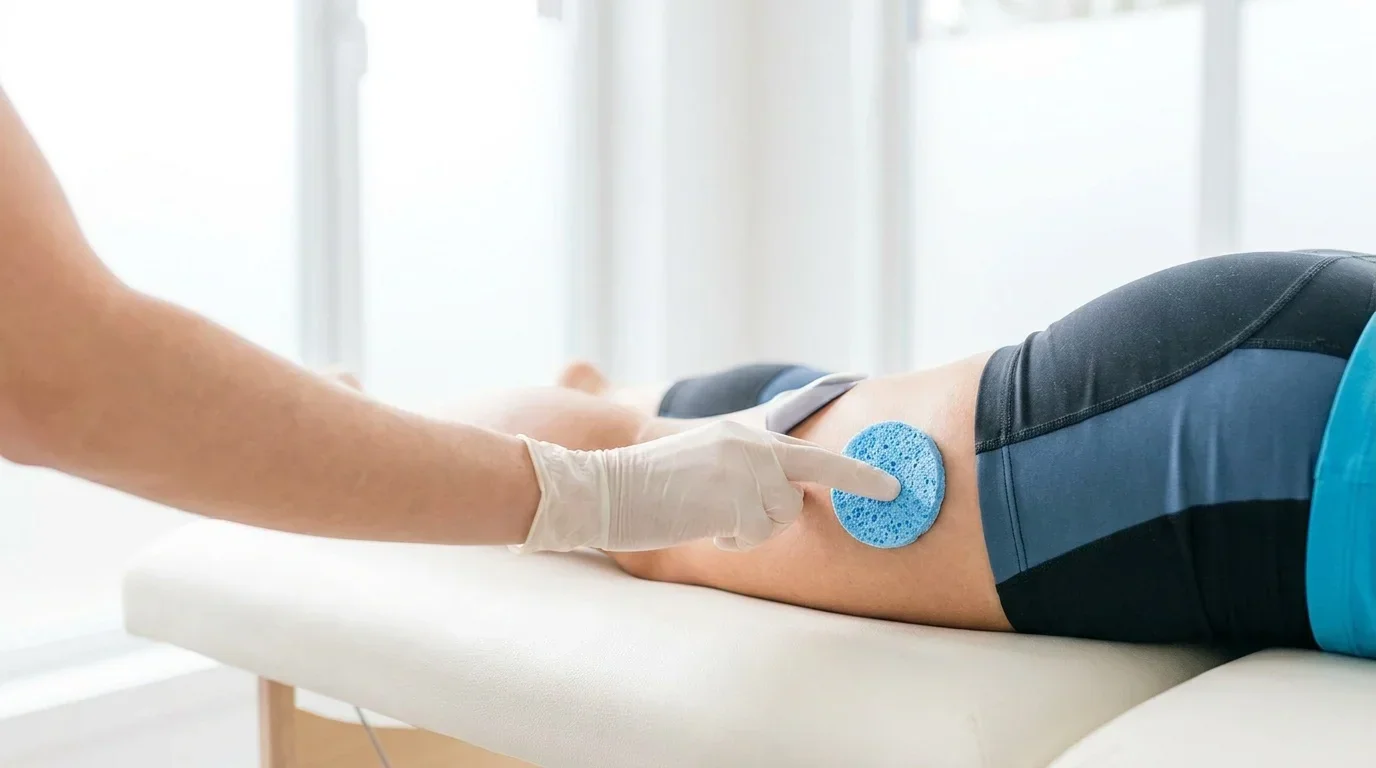
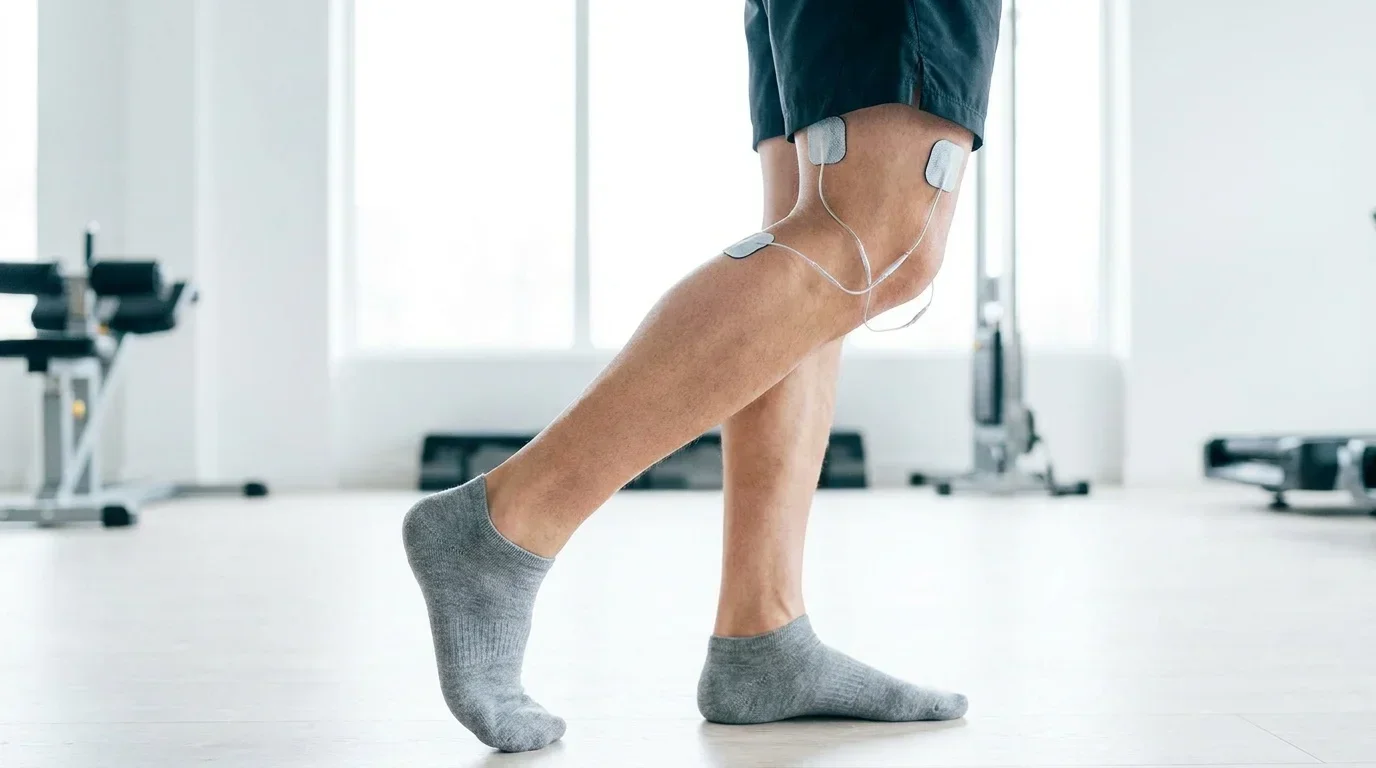
I have seen many athletes benefit from a combination of direct current e-stim and movement at the same time. The stimulus helps the brain to identify the quad MUCH faster than exercise alone. If there is a tight hamstring keeping the quad from firing, we will be able to help that as well.
The direct current e-stim can be used to identify the exact areas where your nervous system is guarding the most. The areas where guarding occurs is what keeps the quad from firing.
Once we identify these areas, we'll coach you through exercise with the stimulation on. By doing so, the brain gets a stronger signal throughout the range of motion, teaching it how to activate again.
One of our athletes, Brian, improved his quad strength symmetry from 57% to 81% in one month, as measured by his PT.
(If you're wondering how direct current e-stim differs from the e-stim unit in your PT's clinic, I break that down in TENS vs EMS. You can see what it shows about the quad in this video.)
If you've done the ice and quad work for a few weeks and the quad still won't fire, it's possible your nervous system needs a stronger signal than exercise alone can give it. That's exactly where we can help.
Feel It On Your Own Knee
The fastest way to understand just how beneficial the Embodi³ ACL Recovery program can be is to feel it, which is why we offer a free 2 day trial.
We'll ship the device to your home, guide you through exactly how to use a direct current e-stim device, take you through a workout, and show how quickly you can start to see improvement.
All of this will happen within the guidelines provided by your PT and surgeon.
If you're ready to get started with it, go ahead and apply for the 2 day trial using the link below.
Your brain is doing its job by protecting the knee. Now it's your job to show it the knee is safe to use again. Let's get to work 💪.
References
- Sonnery-Cottet B, Hopper GP, Gousopoulos L, Pioger C, Vieira TD, Thaunat M, Fayard JM, Freychet B, Cavaignac E, Saithna A. Incidence of and risk factors for arthrogenic muscle inhibition in acute anterior cruciate ligament injuries: a cross-sectional study and analysis of associated factors from the SANTI Study Group. American Journal of Sports Medicine. 2024;52(1):60-68. https://pubmed.ncbi.nlm.nih.gov/38164669/
- Hart JM, Kuenze CM, Diduch DR, Ingersoll CD. Quadriceps muscle function after rehabilitation with cryotherapy in patients with anterior cruciate ligament reconstruction. Journal of Athletic Training. 2014;49(6):733-739. https://pmc.ncbi.nlm.nih.gov/articles/PMC4264644/
Embodi³ is a coaching program, not medical care. Talk with your surgeon and your physical therapist before you start a new exercise or device.