
(This one is about a 4 minute read.)
"How long until she plays again?" is the first question almost every parent asks me, usually on a call a few days after the MRI.
While some athletes return sooner, the short answer is that the ACL recovery timeline for most high school and college athletes runs about 9 to 12 months from surgery to full return to sport.
In this article, I'll show you each phase and where I see athletes lose time.
How Long Is ACL Recovery After Surgery?
Most surgeons recommend a recovery process of 9-12 months after ACL surgery. These time frames are based on the expected time it will take for the new ACL (the graft) to become a strong ligament.
Depending on your surgeon, they may elect to clear your athlete sooner than 9-12 months, based on functional performance testing. Although it isn't generally recommended, we have seen athletes return to sport as early as 4.5 months after surgery.
The ACL Recovery Timeline, Phase By Phase
Assuming a 9-12 month recovery timeline, here is what each phase of the ACL recovery process looks like, along with key milestones to reach in each phase. This table is based on the MOON rehab guidelines from the Multicenter Orthopaedic Outcomes Network, a group of orthopedic surgeons and researchers [1].
| Phase | Rough timing | Milestone to move on |
|---|---|---|
| Prehab | Before surgery | Normal walking, knee bends to 120 degrees, 20 locked-knee leg raises |
| 1. Right after surgery | Surgery to week 2 | 20 locked-knee leg raises, off crutches |
| 2. Early rehab | Weeks 2 to 6 | Full range of motion with little swelling or pain |
| 3. Strength and control | Weeks 7 to 12 | Running and hopping without pain or swelling |
| 4. Advanced training | Weeks 13 to 16 | Hop tests at 75 percent of the other leg |
| 5. Return-to-sport training | Week 17 and on | Strength and hop tests at 85 percent of the other leg |
| Full return to sport | Often 9 to 12 months | Your surgeon's clearance |
The weeks are rough. Your athlete moves to the next phase when they hit each milestone.
Where Do Athletes Lose Time?
The most common reason I see is that the brain shuts down the quad to protect the knee (arthrogenic muscle inhibition). Think of a person who starts shivering when it's 70 degrees outside. The alarm is set far too sensitive, and almost every milestone above runs through the quad.
Once your surgeon or PT clears quad sets, try a quick check. Have your athlete sit with both legs straight, put two fingers just above and to the inside of each kneecap, and squeeze the thigh. If the surgical side stays soft, tell your PT. I go deeper on this in Why Won't My Quad Turn On After ACL Surgery?
Can You Speed Up ACL Recovery?
There are two parts to this question that need to be considered.
Can an athlete improve functional ability faster after ACL surgery?
Will the athlete return to sport faster after ACL surgery?
To answer the first question, yes, an athlete can absolutely improve functional ability faster after ACL surgery. Every athlete's recovery is different. Some feel better much more quickly and others hit plateaus that cause delays.
As an example, the average athlete working with direct current e-stim and Embodi³ protocols improves functional ability about 2x more quickly than the typical ACL recovery, according to Lower Extremity Functional Scale scores [2]. That's from my own tracking of the athletes I've coached, and it isn't a promise for yours.
This leads us to the second question. Does it mean that the athlete will be cleared for return to sport more quickly?
Not necessarily. Whether or not an athlete returns to sport faster is dictated completely by the surgeon and physical therapist's timelines. Often times, they will recommend athletes do not return to sport until 9-12 months after surgery, regardless of functional ability, in order to give the new ligament time to become stronger. A 2016 study of 106 athletes in the British Journal of Sports Medicine found that the re-injury rate dropped by 51 percent for each month they waited to return to sport, up to 9 months [3].
How To Incorporate Direct Current E-Stim Into Your ACL Recovery
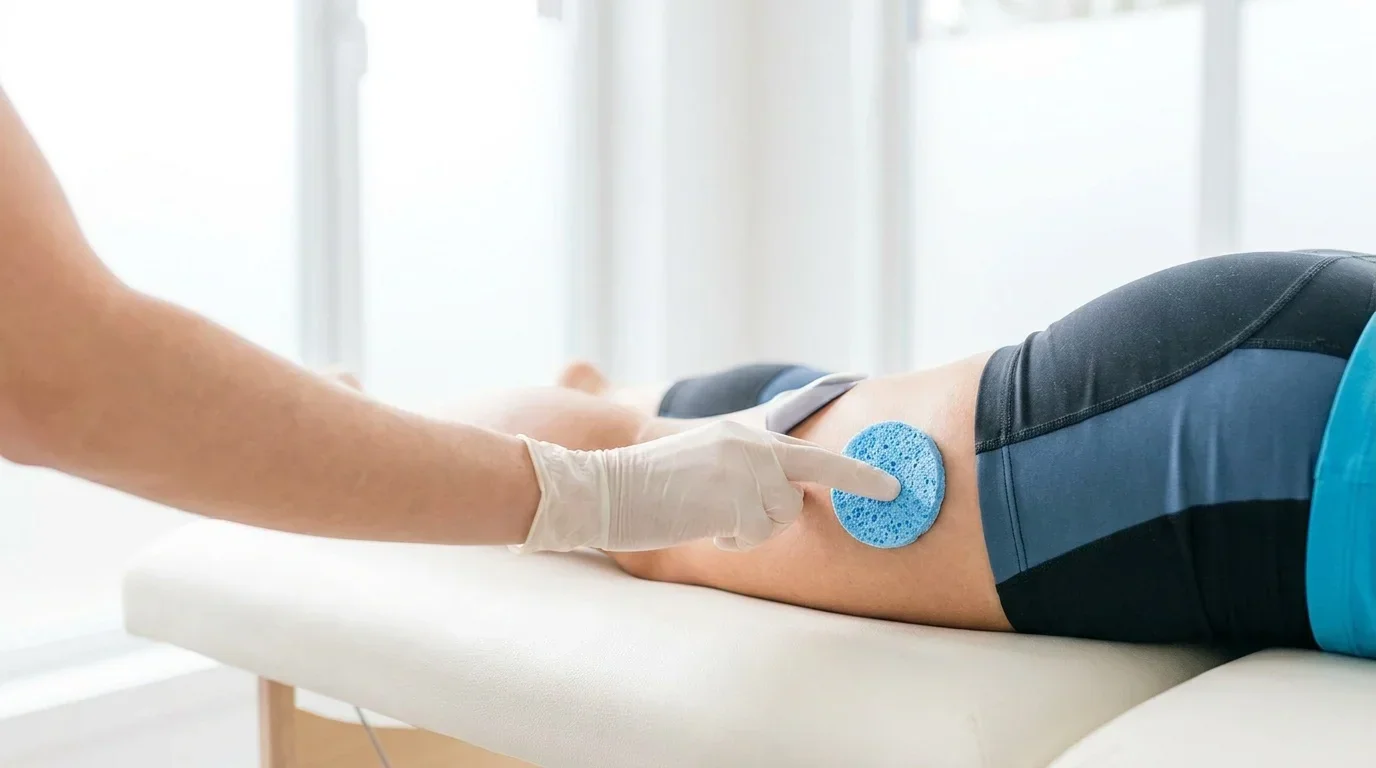
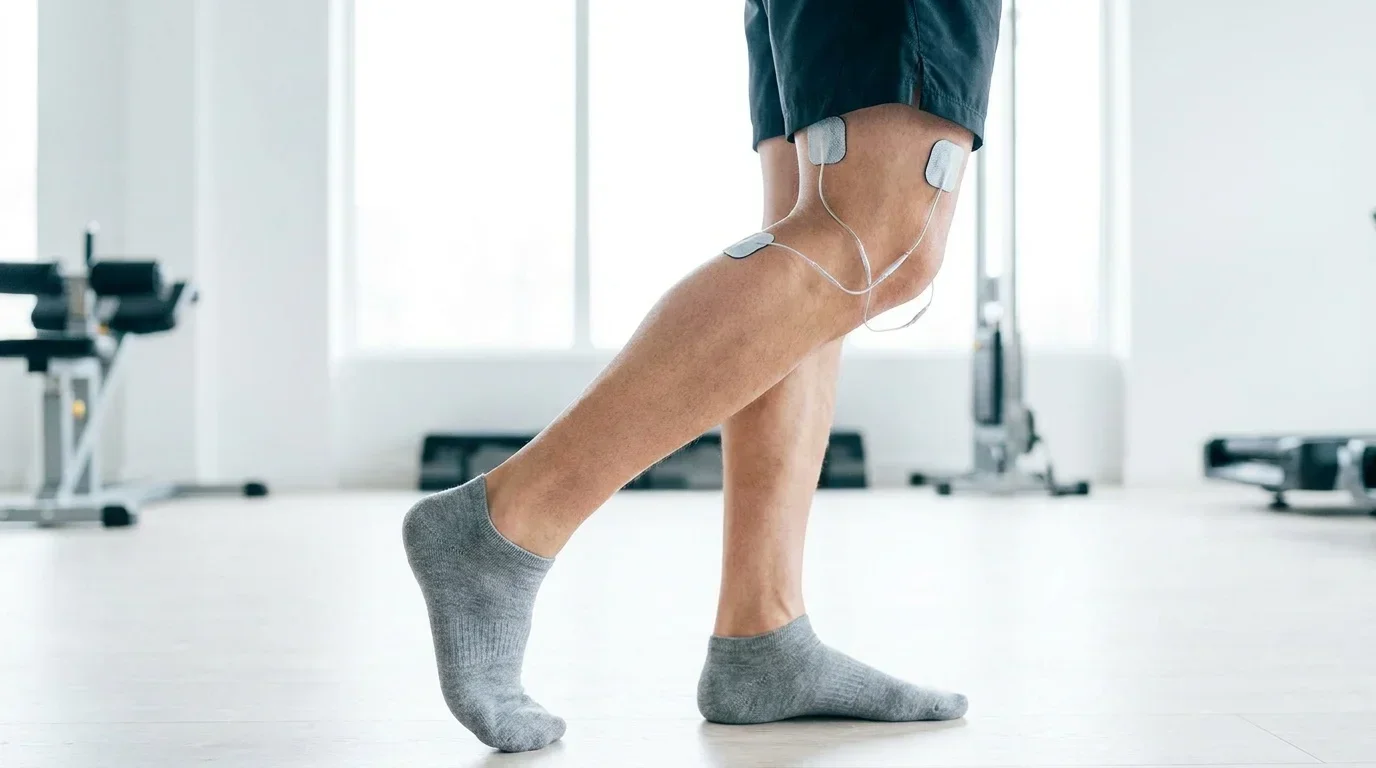
Direct current e-stim can be used to provide an extra boost to an athlete's recovery process. We often work with athletes who are focused on optimizing their recovery as much as possible. Other athletes find us after they have fallen behind on the timeline, and we work with them to get back on track.
At Embodi³, a direct current device goes to your home, and I coach your athlete over live video while they move with it on. First we map the leg to find the muscles the nervous system is guarding, and then we stimulate those muscles during targeted exercises. Every step stays within your surgeon's guidelines, and we work alongside your athlete's PT.
Brian was 13 when he tore his ACL (plus four other ligaments and two pieces of cartilage) playing basketball. His dad found my work on Instagram about two months after surgery. When Brian started, his PT measured his quad strength at 57 percent of his other leg. One month later, the same PT measured 81 percent.
The coaching is remote, and Ella said it better than I can: "Even though I'm miles away from working with Zach, I still feel like it's really one-on-one."
If the quad still won't turn on, or surgery is coming and you want to use the prehab weeks well, book the free 2-day trial. Your athlete works with me for two days, and we both find out if it's a fit before you commit to anything.
Book your free 2-day trial here
Not ready yet? Get the free ACL white paper.
If questions come up about your athlete's recovery, please do not hesitate to reach out to me directly at zach@embodi3sports.com.
References
- Multicenter Orthopaedic Outcomes Network (MOON). MOON ACL Rehabilitation Guidelines. Vanderbilt University Medical Center, Vanderbilt Sports Medicine. https://www.vumc.org/sports-medicine/sites/vumc.org.sports-medicine/files/public_files/documents/MOON%20VSM%20ACL%20Guidelines.pdf
- Binkley JM, Stratford PW, Lott SA, Riddle DL. The Lower Extremity Functional Scale (LEFS): scale development, measurement properties, and clinical application. Physical Therapy. 1999;79(4):371-383. https://pubmed.ncbi.nlm.nih.gov/10201543/
- Grindem H, Snyder-Mackler L, Moksnes H, Engebretsen L, Risberg MA. Simple decision rules can reduce reinjury risk by 84% after ACL reconstruction: the Delaware-Oslo ACL cohort study. British Journal of Sports Medicine. 2016;50(13):804-808. https://bjsm.bmj.com/content/50/13/804
Embodi³ is a coaching program, not medical care. Talk with your surgeon and your physical therapist before you start a new exercise or device.