(This one is about a 4 minute read.)
PTs tell me the same story all the time. An athlete walks in a few weeks after a knee injury, sets a small box on the table, and says, "I got this cool electric machine that's going to help me get my muscle back." They open the box, and it's a TENS unit.
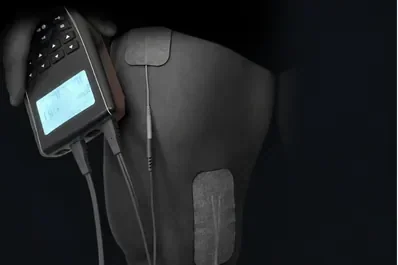
A TENS unit is built to ease pain, and on a pain setting it doesn't make a muscle work hard enough to build it. EMS (called NMES in the research) is built to make the muscle contract, and that's the one with strong evidence for strength after an injury like an ACL tear. If you bought a TENS unit to get your quad back, you didn't do anything wrong, because the boxes look almost the same.
What Is The Difference Between TENS And EMS?
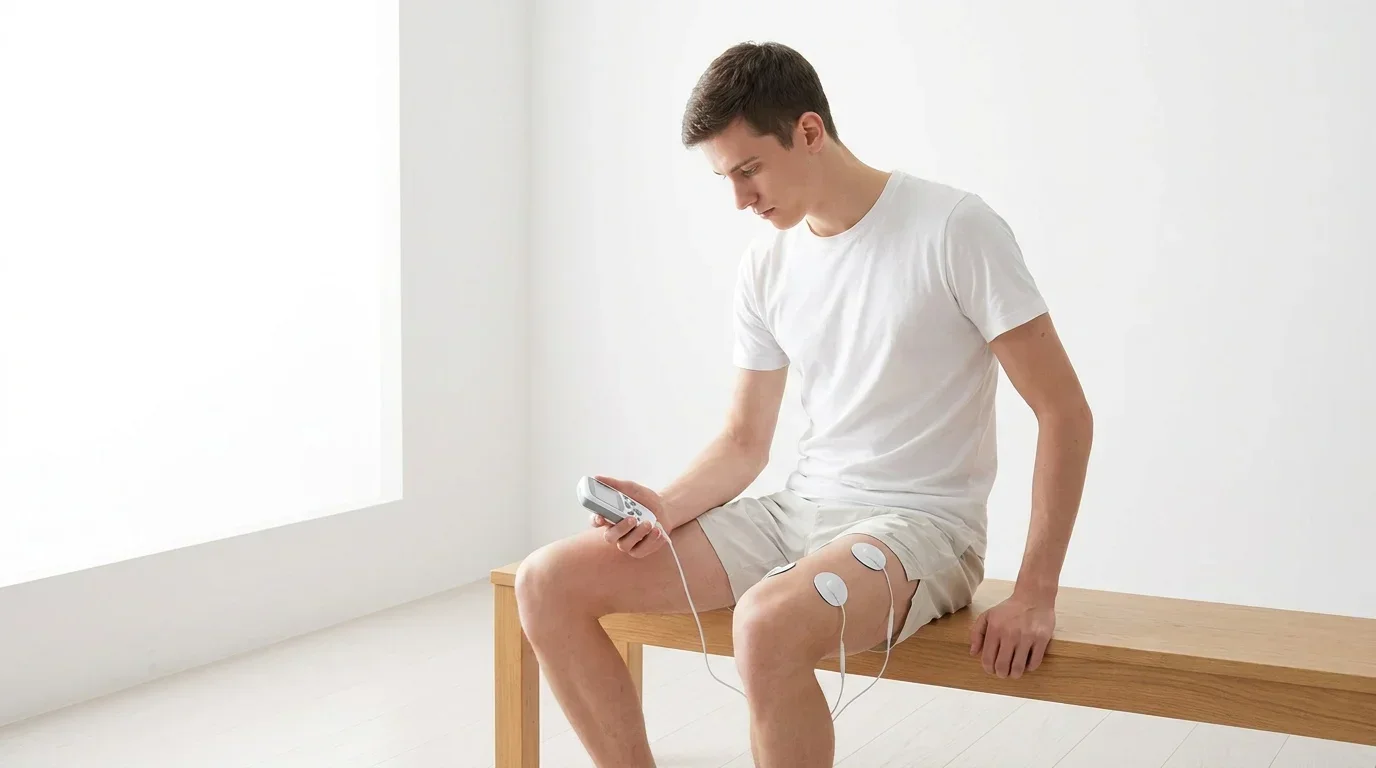
Both are e-stim (electrical stimulation), where a small device sends current through pads on your skin to the nerves underneath.
TENS stands for transcutaneous electrical nerve stimulation (transcutaneous just means "through the skin"). It works on the nerves that carry feeling, and it likely eases pain by blocking pain signals and raising your endorphins [1]. The research on that is solid, and the meta-TENS study in BMJ Open (2022) pooled 381 trials with 24,532 people and found that pain was lower during or right after TENS compared with a placebo [2].
EMS stands for electrical muscle stimulation. The current reaches the nerves that run the muscle, and you can see the muscle tighten and hold. After an injury, your brain is the coach calling the quad into the game, and the quad isn't answering. EMS is a second voice on the sideline making the same call, loud enough that the muscle has to respond.
Can A TENS Unit Build Muscle?
On a TENS setting, no. Building muscle takes a hard contraction, repeated over weeks, and a TENS program for pain runs at a comfortable tingle. Many home units are also combo units with TENS and EMS programs on one device, so you may own both without knowing it.
How Can You Tell Which One You Own?
You can check this today in five minutes.
- Read the label and the manual for TENS, EMS, NMES, or "muscle stimulator."
- Open the program list. Muscle programs usually let you set a work time and a rest time.
- If your surgeon or PT has cleared you for e-stim, put the pads on the front of your thigh, start at zero, and turn it up slowly.
- Watch the muscle. A tingle with no change is sensory stimulation. A muscle that tightens on its own is a contraction.
Then ask yourself two things. Does your kneecap slide up toward your hip? Could someone across the room see the contraction? If not, you're holding a pain tool.
Skip TENS or EMS if you're pregnant or have a pacemaker, epilepsy, heart disease, a blood clot, or cancer, and keep the pads off the head, the neck, and broken or numb skin [1]. Your manual has the final word.
What Does The Research Say About E-Stim After ACL Surgery?
After an ACL injury or surgery, the brain turns the quad down to protect the knee (I explain why in Why Won't My Quad Turn On After ACL Surgery?).
A 2018 review of 11 randomized trials found that NMES added to physical therapy improved quad strength and function more than physical therapy alone in the first 4 to 12 weeks after ACL surgery [3]. The 2017 American Physical Therapy Association guideline gives it its top grade (A): NMES "should be used for 6 to 8 weeks to augment muscle strengthening exercises" after ACL reconstruction [4]. The ACL recovery timeline shows where those weeks fall.
The dose matters. In a 1995 trial of 110 people right after ACL reconstruction, the groups that got high-intensity NMES reached 70 percent or more of the strength of the other leg in four weeks, compared with 57 percent for hard exercise alone and 51 percent for low-intensity stimulation [5]. Every group in that trial also did its stimulation with the knee held still [5].
Where Does Direct Current E-Stim Fit?
I've spent about 10 years combining direct current stimulation with exercise, and it's how we coach every athlete at Embodi³. It's a different technology with its own protocols. Most home units push the current one way and then back, while the direct current e-stim I use sends each pulse in one direction.
To map the body, I move a small sponge electrode over the muscles, and the stimulation asks the nervous system, "Are you okay firing this muscle?" When the answer is no, the athlete usually jumps, and that shows us the muscles the brain is guarding. Then the athlete moves through exercises picked for their stage with the stimulation on, while I watch every rep over video. Most stim units hold the muscle tight while you sit still. The athletes I coach train through full movements with direct current on, so the muscle learns to create and absorb force again.
Brian, a 13-year-old basketball player, took his quad strength from 57 percent to 81 percent of his other leg in one month, as measured by his PT. That's one athlete, and every recovery is different.
If you've used EMS with your PT for a few weeks and the quad still won't answer, your nervous system may need a stronger signal during real movement. That's where we can help.
Feel It On Your Own Knee
In a free 2-day trial we ship the device to your home, map where your nervous system is guarding the knee, and show you what changes when you move with it on. It all happens alongside your PT and within your surgeon's guidelines.
Pick the right tool for the job, then get to work.
References
- Cleveland Clinic. Transcutaneous Electrical Nerve Stimulation (TENS). https://my.clevelandclinic.org/health/treatments/15840-transcutaneous-electrical-nerve-stimulation-tens
- Johnson MI, Paley CA, Jones G, Mulvey MR, Wittkopf PG. Efficacy and safety of transcutaneous electrical nerve stimulation (TENS) for acute and chronic pain in adults: a systematic review and meta-analysis of 381 studies (the meta-TENS study). BMJ Open. 2022;12(2):e051073. https://pubmed.ncbi.nlm.nih.gov/35144946/
- Hauger AV, Reiman MP, Bjordal JM, Sheets C, Ledbetter L, Goode AP. Neuromuscular electrical stimulation is effective in strengthening the quadriceps muscle after anterior cruciate ligament surgery. Knee Surgery, Sports Traumatology, Arthroscopy. 2018;26(2):399-410. https://pubmed.ncbi.nlm.nih.gov/28819679/
- Logerstedt DS, Scalzitti D, Risberg MA, Engebretsen L, Webster KE, Feller J, Snyder-Mackler L, Axe MJ, McDonough CM. Knee Stability and Movement Coordination Impairments: Knee Ligament Sprain Revision 2017. Journal of Orthopaedic & Sports Physical Therapy. 2017;47(11):A1-A47. https://doi.org/10.2519/jospt.2017.0303
- Snyder-Mackler L, Delitto A, Bailey SL, Stralka SW. Strength of the quadriceps femoris muscle and functional recovery after reconstruction of the anterior cruciate ligament. A prospective, randomized clinical trial of electrical stimulation. Journal of Bone and Joint Surgery (American). 1995;77(8):1166-1173. https://pubmed.ncbi.nlm.nih.gov/7642660/
Embodi³ is a coaching program, not medical care. Talk with your surgeon and your physical therapist before you start a new exercise or device.