
Why Does My Son’s Elbow Pain Keep Coming Back?
What Parents Need to Know When Rest, Physical Therapy, and Time Aren't Solving the Problem
A few weeks ago, I was on the phone with a dad who was expressing his confusion for the best way to help his son navigate his arm injury.
“I don’t get it,” he said.
“We’ve done everything they’ve told us to do - rest, ice, physical therapy.. All of the band exercises in the world. But his elbow pain just keeps coming back.
Adding to the confusion, the MRI results came back completely clean.
With this being the third or fourth time his son had been through the cycle, they were starting to feel like there just may not be a workable solution.
From experience, I can tell you that there are many parents out there in this situation - searching for answers about recurring elbow pain and why their son’s arm pain keeps coming back after pitching.
If this is you, I want you to know something - this is extremely common. I’ve talked to parent after parent who is frustrated, confused, and just wants to do what’s best for their son. The answers just aren’t coming as clearly as they would like.
So, I thought I’d take a few minutes to write this article to offer a little more clarity, and hopefully confidence to the next steps for your son’s arm pain.
Let’s break it down, piece by piece.
To understand these problem fully, we need to understand the following:
What is pain and what is it really telling us?
Why is the body sending pain signals?
Why rest doesn’t always fix elbow pain
How we can use this information to make an informed approach for our son
Several easy tips to apply to help guide your son’s recover
What is pain and what is it really telling us?
My explanation for pain is quite simple -
Pain is an alarm, sent by the brain, in response to something that it perceives to be a threat.
In relation to your son’s elbow pain, his brain has been taught to perceive pitching as a threat in some way. Any sustainable solution will use this information to lower the “threat threshold’ imposed by the brain as it relates to pitching.
Why is the brain sending pain signals in response to pitching?
We can’t say for sure, but in many cases, the brain begins to perceive an activity as threatening when more stress is put into a joint than it is designed to handle.
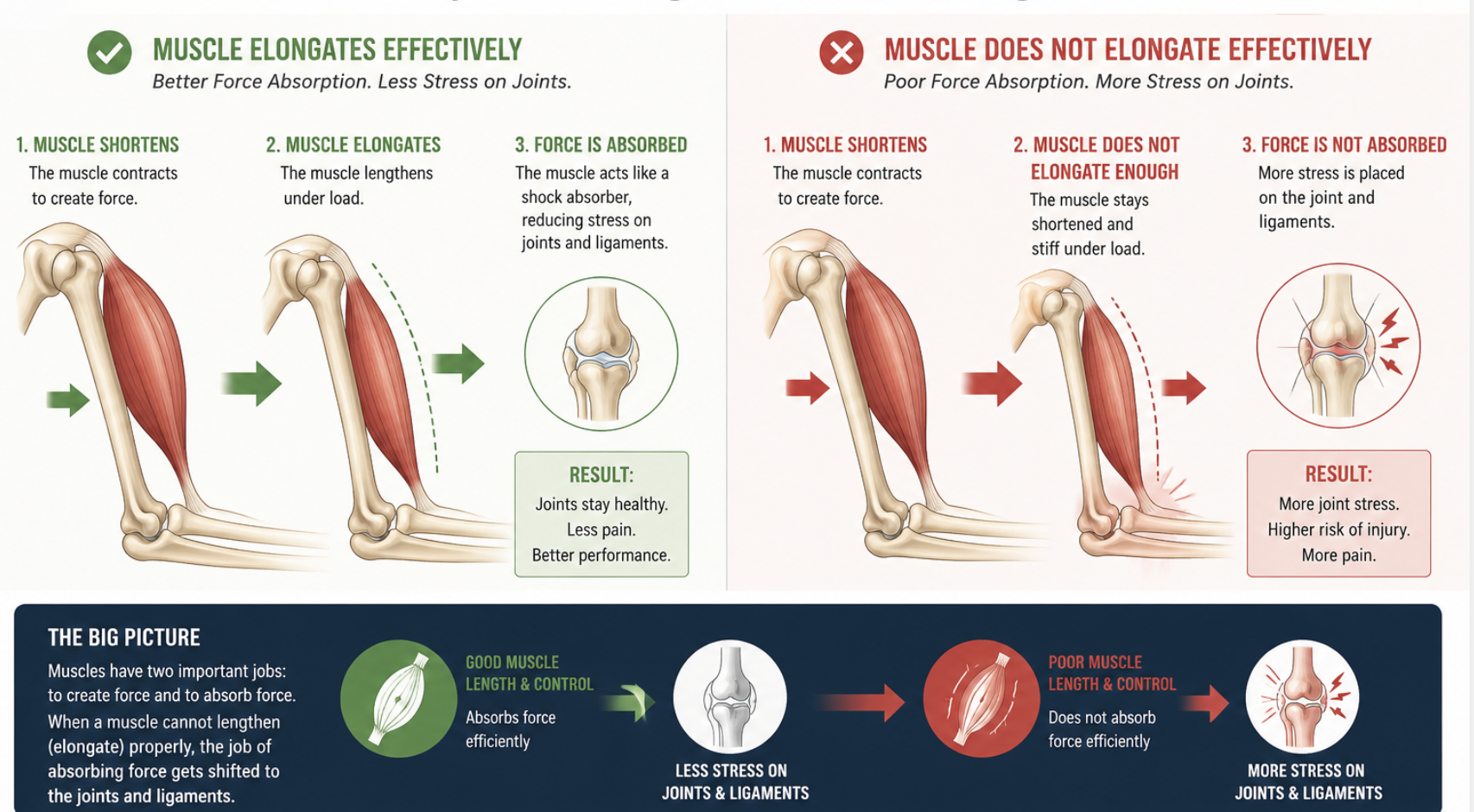
Joints take on more stress than they were designed for when the muscles around the joint fail to create and absorb force to their fullest capacity.
This often occurs when muscles are overworked and/or underdeveloped. In pitching, overworked muscles are very common. An overworked muscle becomes a fatigued muscle, which is more likely to stay in the shortened state.
When a muscle stays in the shortened state, it does not absorb force as effectively, causing joints to take on more stress.
Why Rest Doesn’t Always Fix Elbow Pain
I’ve talked to so many parents who are frustrated with the cycle - their son rests for a bit, the elbow pain goes away, the son starts pitching again, and the elbow pain comes right back.
While rest does offer a temporary solution, it often does not offer the full solution.
Remember, this elbow pain likely exists because the muscles around the joint are not creating and absorbing force as well as they should be.
Resting puts a temporary stop to the forces going into the joint; however, it does not address the underlying cause - muscles not doing their job to support the joint. Therefore, when your son returns to pitching, the forces into the joint resume, and the pain comes back.
Putting An End To The Cycle
Here’s a few tips that can help you to guide your son’s recovery and return to pitching more effectively.
1) Ask your son to rate their pain levels on a 1-10 scale while returning to pitching. If pain exceeds a 2/10, it is most optimal to stop pitching that day.
When we approach a pain level of a 0, 1, or 2 out of 10, it is an opportunity for us to work into the pain a bit more. The brain may have a false threat perception from pitching - continuing to pitch into these pain levels can help to lower the threat perception.
However, if pain exceeds a 2/10, continuing to pitch into greater pain will likely raise the threat perception by the brain, increasing the chance for more pain.
It’s also possible at this level that we are putting great stress on the joint and surrounding tissues, leading to potential physical injury.
2) If your son is doing exercises for their arm care, make sure they understand the intent of each exercise and what it feels like to execute it properly.
Truly understanding why you are doing an exercise and what it feels like do the exercise properly can be the make or break between it being something that is helpful or not helpful.
I see way too many pitchers just waving their arms around with bands in their hands, without stopping to think what muscle should be working, and what it feels like for that muscle to be doing the work.
If a pitcher can develop this understanding for their exercises, they will position themselves much better for success in their arm care program.
If you’re ready for a different approach, that drives fast progress-
This is where my work comes in.
I mentioned earlier that the majority of recurrent elbow pain is caused by muscles that do not create and absorb force well around the joints.
Using a combination of direct current electrical stimulation and exercise, I have helped pitcher after pitcher to identify which muscles are causing the problems and turn them back on.
I’ve worked with pitchers who have been through years of PT, surgeries, and band exercises looking for a solution.
Within a matter of weeks, I’m able to get their elbows turned around and in a better position.
In many cases, they even are able to gain velo at the same time - it’s all about finding the problem causing muscles and turning them back on.
Within the program, pitchers will gain much more confidence in their arms and that they have technology and protocols that will work for them anytime, anywhere.
If you’d like, feel free to reserve a time on my calendar using the link below - I’m happy to jump on a call, hear more about your son’s arm troubles, and answer any questions you might have about how my work will help make sure his arm gets healthy and stays healthy long term.
You can also send me an email at zach@embodi3sports.com.
